
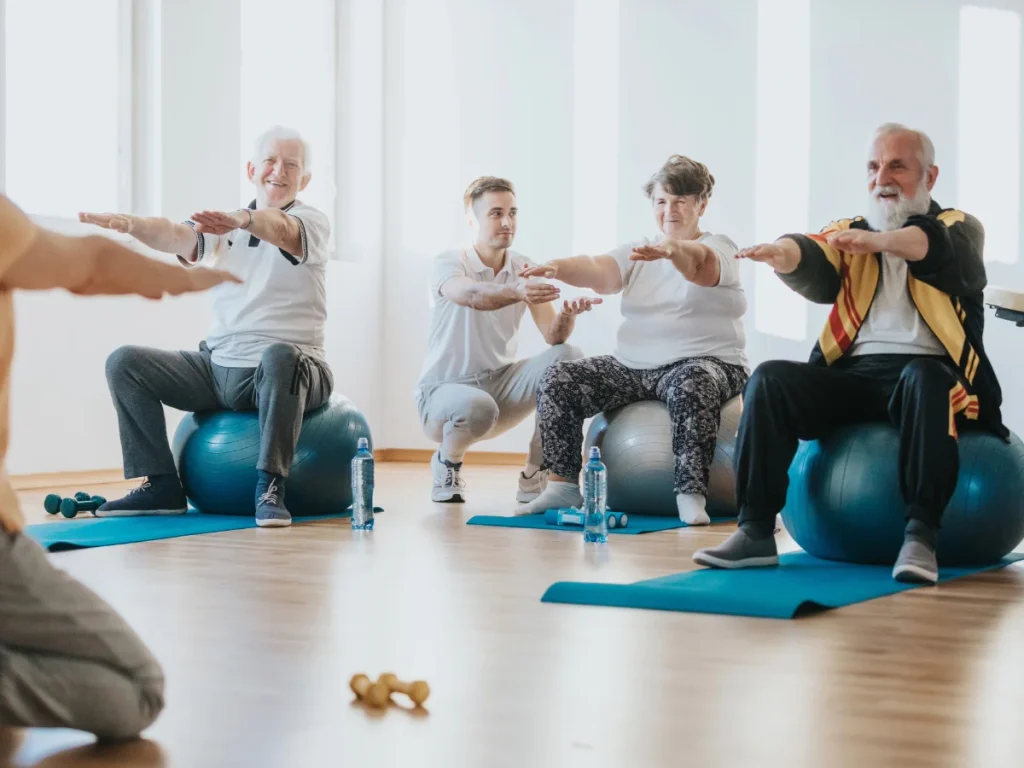
Our guide to some simple exercises for older people to keep them fit even if they have limited mobility. Adaptations can be made to exercises for older people with limited mobility so that they can continue to benefit from daily exercise even when they are physically disabled or restricted in movement. Exercise can improve balance, maintain physical fitness, be good for mental health and reduce the risk of disease or accidental falls. Attending group exercise classes is good for morale and for health. There are many different types of exercise, so there is plenty to choose from when looking for exercises that are fun, enjoyable and good for us.
Always seek medical advice before starting any exercise plan.
Why Exercise Matters
As we get older and our mobility lessens, it is more difficult to stay active and get the right amount of exercise. But exercise is good for us. It improves our strength and flexibility. It helps us to stay independent for longer. It improves balance and reduces the chances of falls. It keeps us healthy and less likely to suffer from chronic illness e.g. heart disease and high blood pressure (NHS).
Safety and precaution
Before you start any form of exercise, always consult with a medical professional. The exercises in this article are not intended to replace medical advice. Choose appropriate support e.g. a stable chair or a secondary adult to ensure your safety. Our community care and access team would be pleased to support you while you exercise. Start slowly and listen to what your body tells you. These exercises should not be painful or cause strain. For formal exercise classes, wear comfortable and non-restrictive clothing.
Exercises for limited mobility
There are exercises for limited mobility including those who are sitting down in a chair or wheelchair for most of the day. Seated exercises can help improve mobility and circulation.
Wrist moves and ankle rolls are simple to do and can improve circulation after a long period of sitting. Simply move your hands or feet in circles or roll your ankle so that your heel is facing upwards. Ankle rolls can be done while seated or while standing, using support if needed.
Knee marches improve hip mobility. Stand with the aid of a walking device or chair. Lift your knee as high as it is comfortable to do so. Put your foot back on the floor. Repeat the knee lift with the other leg. ‘March’ on the spot for a few repetitions. Hip marching can also be done while seated on a chair. Lift each knee one at a time while sitting in a chair.
Seated rows correct your posture. They require a resistance band – these can be bought from sport or yoga stores. Sit in a chair with your feet flat on the floor and the resistance band under your feet. Hold the ends of the resistance band in your hands, palms facing each other. Pull the ends of the resistance band towards your chest. Do not strain yourself. Release and repeat.
Calf raises improve balance and strengthen the legs. Sit in an upright chair. Move your heels to behind your knees on the floor. Raise your heels up so that you are on your tiptoes. Return your heels to the floor. Repeat.
Heel slides also strengthen the hips. Lie down on a bed with your legs straight. Raise one knee, sliding the heel along the sheet beneath it until the knee and ankle are bent but the sole of the foot is still on the bed. Hold briefly. Return the leg to lie on the bed. Repeat with the other leg.
Low impact exercise classes
Low impact exercise classes are useful for two reasons. The classes increase social interaction with others in the same group. They increase the likelihood of continuing to exercise as they are held at a regular time and place. Our community care and access team would be happy to assist you in attending a low impact exercise class. We can provide transportation to classes.
Low impact exercises
Tai Chi improves flexibility and balance. It is a Chinese exercise routine that combines gentle movement and precise placement of the body, meditation and breathing techniques. Chair yoga is an adapted version of yoga for various physical conditions. Pilates enhances core strength. It’s a mind-body training developed by a physical trainer. Chair based Zumba dance classes combine movement with music while seated. Low impact exercises can improve flexibility and balance and reduce the risk of falling.
Water based exercises
Water based exercise classes use buoyancy to support the body while the exercise is taken. These can be as simple as walking in shallow water and automated lifts can be used for those who can’t stand or enter the water by themselves. Aqua aerobics is a series of exercises done while standing or swimming in the pool. Aquatic workouts are good for joint mobility and can help reduce joint pain.
Chair based strength training
Gym techniques can be used by a personal trainer to exercise. They use the body’s own weight for resistance and can be done while seated. It is important that the correct posture is adopted, so this type of training is best done under supervision with a physical trainer who will make modifications for different mobility levels.
Daily exercise for older adults
Make exercise a part of daily routine but set realistic goals and start small with fewer repetitions and intensity. Exercise is meant to be beneficial so focus on being consistent and not perfect. Daily exercise will help maintain fitness in the longer term and increase mobility, while reducing risk from chronic illness and falls.
There are suitable exercises to do whatever the age or mobility limitation. Find a way to exercise that is fun, enjoyable and safe for your personal circumstances. Keeping fit and healthy is good for mental and physical health at any age, but it is particularly good for older adults to maintain strength and balance. We hope this has inspired you to exercise in some way. Contact our care team for in home care support if you need help at home.